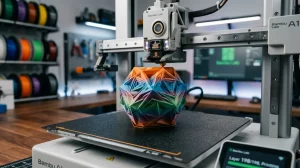
Every electronic project eventually needs a housing. A bare circuit board on a desk works for testing, but a finished device needs protection from dust, accidental contact and mechanical damage. Off-the-shelf enclosures rarely fit perfectly: holes are in the wrong places, the size is not quite right and the look is generic. A custom 3D printed enclosure solves all of these problems. Drukuje3D prints enclosures for hobby electronics, IoT devices, sensors, controllers and small production series.
3D printing allows the enclosure to be designed around the electronics, not the other way round. Mounting posts, cable openings, ventilation slots and openings for displays, buttons and connectors can all be placed exactly where they are needed.
Typical enclosure projects
- housings for microcontroller boards and single-board computers,
- cases for sensors and smart home devices,
- enclosures for measurement equipment and controllers,
- front panels with openings for displays and buttons,
- battery compartments and covers,
- mounts for DIN rails and wall installation.
Designing a good enclosure
A well-designed enclosure takes several factors into account. The PCB should sit on mounting posts with holes for screws or heat-set inserts. Connectors need precise openings with a small clearance. Electronics that generate heat need ventilation. The lid should close securely, with screws or snap-fits. Drukuje3D can print an enclosure from your model or help design one based on board dimensions and component positions.
Material choice for electronics
PLA is fine for indoor prototypes and devices that do not get warm. PETG is a good all-round choice for finished devices and those used in humid environments. ABS is preferred where components generate more heat or where the enclosure will be painted. TPU can be used for flexible elements such as gaskets, protective bumpers and button covers. You can find information about materials and ordering at https://drukuje3d.com/en/3d-printing-service/.
Precision and fit
FDM printing typically holds tolerances of a few tenths of a millimetre. For enclosures, that means designing openings and posts with a small margin. If the fit is critical, Drukuje3D can print a test section – for example only the panel with connectors – to check alignment before printing the full housing.
Surface finish
A finer layer height gives a smoother surface for visible panels, while thicker layers make internal or hidden parts faster to print. Text, logos and labels can be embossed or engraved directly in the model, so the device looks finished without additional stickers.
From one-off to small series
Makers often start with a single enclosure for a personal project, then need ten or twenty for a small batch of devices. Drukuje3D can repeat the same print with consistent settings, so every enclosure in a series fits the same boards.
Important limitations
Printed plastic enclosures are not certified for mains voltage safety requirements or explosion-proof environments. For such devices, certified housings must be used. For low-voltage electronics, prototypes and hobby projects, a printed enclosure is an excellent solution.
Summary
A custom 3D printed enclosure from Drukuje3D protects your electronics, fits perfectly and gives your project a professional look. Send a model or board dimensions, and receive a housing designed for your device.